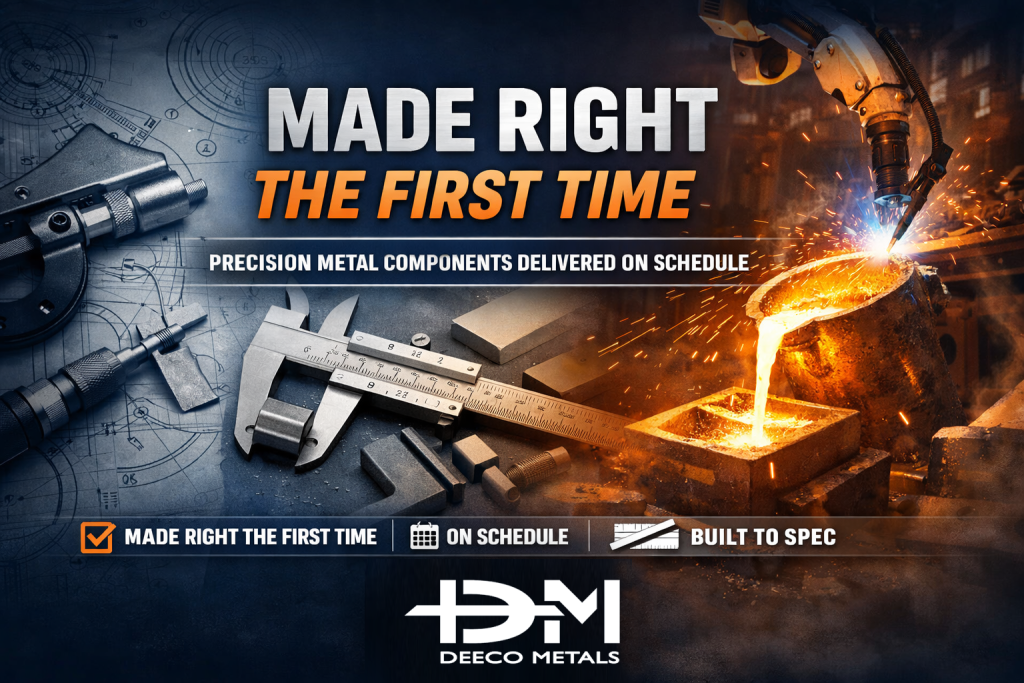
Precision Metal Components Made Right the First Time

Precision metal components rarely allow for “close enough.” A few thousandths off can mean fit issues, rework, delayed installs, and uncomfortable phone calls that start with, “We have a problem on site.”

Whether you are an OEM building assemblies at scale or an architect specifying metal components that must look flawless in a finished space, the cost of a bad part is almost never just the cost of the part.

That is why our focus stays simple and measurable:

DEECO Metals helps OEMs, manufacturers, and architects get complex, precision-engineered metal shapes and components made right the first time, delivered on schedule, and built to exact specifications for reliable long-term performance.

This post breaks down what “right the first time” really means in metal sourcing, and how you can reduce risk before production ever begins.


Why “Right the First Time” Matters More Than Ever

In today’s supply environment, delays and quality problems multiply fast:

  • A small dimensional issue turns into assembly downtime.
  • A finish mismatch becomes a rejected lot.
  • A material substitution creates corrosion, discoloration, or premature wear.
  • A late shipment cascades into missed install windows and rescheduled labor.

The solution is not luck. It is disciplined front-end alignment: material, tolerances, finishing, inspection plan, packaging, and lead time all agreed before anyone hits “go.”


The Three Failure Points That Cause Most Rework

1) Specs that do not fully match the real application

Drawings often tell you the geometry, but not always the full story: mating parts, load direction, wear points, installation method, or environment.

A handrail component may need a different finish standard than a hidden structural profile. An electrical copper component may need conductivity and flatness considerations that a general metal profile does not.

The fix: confirm application details early so the specification reflects reality, not just geometry.

2) Material and temper decisions made too late

Two parts can look identical and behave completely differently depending on alloy and temper.

For OEM components, that can show up as cracking during forming, poor machinability, or inconsistent performance from lot to lot. For architectural pieces, it often shows up as finish problems, dents, or wear that appears sooner than expected.

The fix: align on alloy, temper, and performance requirements before quoting is finalized.

3) Lead time assumptions that ignore the full workflow

A promised ship date means nothing if the plan did not account for tooling, sampling, approvals, finishing, packaging, and freight.

The fix: build lead times around the real sequence, not best-case estimates.


What DEECO Does Differently to Reduce Risk?

We treat the quote stage like project planning, not just pricing

The best sourcing outcomes start before production. We look for the details that tend to cause downstream issues, including:

  • tolerance stacking and critical-to-fit dimensions
  • finish requirements and handling considerations
  • inspection points that verify what truly matters
  • packaging needed to protect appearance and geometry
  • schedule realities based on process steps, not assumptions

This approach reduces the odds of surprises after the order is placed.

We coordinate reliable production paths for complex shapes

Many companies can source a basic shape. Complex profiles, specialty alloys, and appearance-sensitive components demand a sourcing path that matches the job.

DEECO’s value is in connecting the application requirements to the right production approach so the part performs as expected and arrives when it is needed.

We plan for repeatability, not just a single shipment

For OEMs especially, consistency matters as much as the first lot. Repeat orders should not require re-learning the project every time.

That is why we emphasize documented specifications, stable workflows, and clear quality expectations.


A Practical “Right the First Time” Checklist

Use this before your next RFQ or order:

  1. Application confirmed: Where is the part used and what does it interface with?
  2. Material defined: alloy, temper, and any performance requirements.
  3. Critical dimensions identified: which features cannot drift and why.
  4. Finish clarified: standard, appearance level, protection in transit.
  5. Inspection plan agreed: what is measured, how often, and how results are shared.
  6. Packaging specified: how parts will be protected and labeled.
  7. Timeline built around steps: tooling, sampling, approvals, finishing, freight.

When these are decided early, projects run smoothly, and costs stay under control.


The Bottom Line

Precision metal components do not fail because people do not care. They fail when details are missed early and discovered late.

DEECO Metals exists to prevent that: by aligning specifications up front, coordinating a reliable sourcing path, and executing with schedule discipline so OEM and architectural projects stay moving.

If you have a profile, component, or custom shape coming up this quarter, the best time to de-risk it is now, before the calendar forces your hand.

📞 Contact your DEECO Metals Sales Representative
📧 sales@deecometals.com ☎️ 800-272-7784 🌐 deecometals.com
Posted in manufacturing, Uncategorized | Tagged , , , , , , , , , | Leave a comment

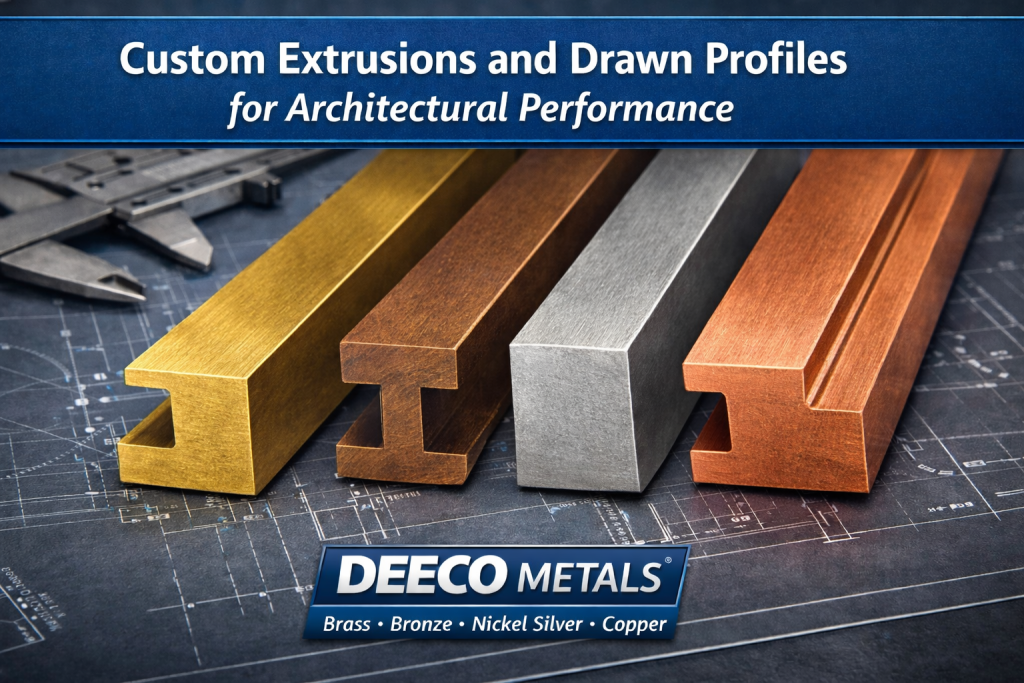
Extruded Brass, Bronze, Nickel Silver, and Copper Shapes and Drawn Brass Alloy Profiles Designed for High-Performance Architectural Projects

Where reliable engineering meets elevated design.

extruded and drawn shapes

Architects and manufacturing engineers depend on materials that perform consistently, look refined, and support long-term use in demanding environments. Brass, bronze, copper, and nickel silver remain some of the most effective choices for profiles that must combine mechanical strength, clean appearance, and dimensional accuracy. When engineered correctly, these alloys deliver the reliability that modern architectural systems require.

DEECO Metals supplies custom extruded shapes in brass, bronze, copper, and nickel silver, along with drawn brass profiles for projects where quality, precision, and timely responsiveness are essential.

Why Brass, Bronze, Nickel Silver and Copper Shapes Work Well in Architectural Systems

These metals offer a balance of strength, corrosion resistance, and formability that is difficult to match. They provide warm, refined finishes that withstand continuous contact, moisture, and heavy use. The alloys handle complex geometries cleanly, are highly machinable, and support premium finishing processes that enable designers to achieve both functional and aesthetic goals.

Customers rely on these materials because they deliver:

• Long-term durability in interior and exterior environments
• Attractive surface finishes suited for premium spaces
• Excellent corrosion resistance for doors, entries, and public areas
• Natural antimicrobial performance for high-touch zones
• Predictable forming, fabrication, and machining results
• Dependable performance when profiles require tight tolerances

These qualities make brass, bronze, copper, and nickel silver a dependable choice for projects where both beauty and function matter.

Custom Brass, Bronze, Nickel Silver and Copper Extrusions Built for Architectural Demands

Extruded copper alloy profiles form the backbone of many architectural features. DEECO engineers each shape to meet exact specifications, ensuring that every detail performs as intended once installed.

These shapes are used in:

• Decorative trims and mouldings
• Sills, thresholds, and specialty transition pieces
• Door and window framing components
• Glazing channels and structural support profiles
• Handrail systems and balustrade elements
• Custom shapes for luxury interiors or branded environments

Each extrusion is produced with consistent straightness, controlled dimensions, and a surface quality suitable for sanding, brushing, polishing, or patina finishes. This reduces fabrication time while maintaining a high-level presentation.

Drawn Brass, Bronze, Nickel Silver and Copper Shapes for Projects Requiring Precision

When an application demands tighter control, drawn brass shapes provide the enhanced performance needed to meet demanding tolerances. The drawing process increases mechanical strength, improves surface uniformity, and sharpens dimensional accuracy.

Customers select drawn shapes when they need:

• Precision fit in assemblies and hardware
• Superior straightness and dimensional stability
• Higher tensile strength for high-use components
• Uniform surfaces for visible trim or finishing
• Repeatability across low to high-volume programs

These profiles are commonly used in locking systems, sliding tracks, glazing beads, specialty channels, and mechanical features that require smooth and reliable operation.

Matching the Right Brass, Bronze, Nickel Silver, and Copper Alloy to the Job

The correct alloy selection ensures long service life and consistent performance. DEECO guides customers toward the best option based on environment, appearance, and fabrication needs.

Architectural projects often use:

C360 free machining brass for profiles requiring extensive machining

C380 and C385 architectural brass and bronze for decorative elements

• C110 ETP copper for electrical conductivity & green or copper-colored accents achieved through acid etching & various patinas

Manganese and naval brasses or bronzes for harsh environments and higher strength requirements

Each alloy brings a specific advantage, and our engineering team helps customers meet both performance and cosmetic objectives.

Why Leading Architectural and OEM Teams Work with DEECO Metals

Customers rely on DEECO Metals because we focus on making their job easier. We combine metallurgy, engineering, global sourcing, and manufacturing experience to produce brass, bronze, copper, and nickel silver shapes that arrive ready for real-world demands.

Our strengths include:

• Custom dies engineered for complex architectural profiles
• Controlled extrusion, roll forming, and straightening processes
• Precision die drawing for close dimensional tolerances
• High-quality surface preparation and finishing support
• Strict dimensional and quality inspection
• Long-term supply programs and JIT inventory solutions
• Reliable lead times through trusted global partnerships

Profiles must install cleanly, operate smoothly, and maintain their appearance for years. Consistency is essential.

Bringing Performance and Design Together

Modern architecture continues to push for materials that elevate appearance while supporting long-term durability. Brass, bronze, copper, and nickel silver deliver on both fronts, and when shaped through advanced extrusion and drawing processes, they become some of the most dependable components in any project.

DEECO Metals supplies profiles engineered with your performance, timeline, and design goals in mind. From low to high-volume OEM programs to signature architectural features, we provide reliable metal solutions that support quality buildings and lasting results.

Looking for a reliable source for custom brass, bronze, copper, or nickel silver shapes?
Request a quote from DEECO Metals. Speak directly with our engineering team via email sales@deecometals.com, visit www.deecometals.com or call 1-800-BRASS-84.

Posted in Extruded Shapes, Uncategorized | Tagged | Leave a comment

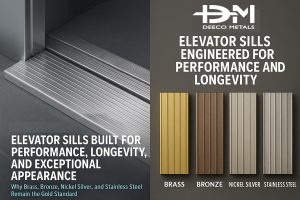
Elevator Sills Engineered for Performance, Longevity, and Exceptional Appearance

Why Brass, Bronze, Nickel Silver, and Stainless Steel Remain the Gold Standard for Elevator Sills

Elevator Sills

In vertical transportation, the elevator entrance is one of the most heavily abused architectural components in any building. Every footstep, rolling cart, dolly, suitcase, or piece of equipment transfers force directly onto the sill. A high-quality sill must withstand abrasion, moisture, debris, impact, and continuous traffic while maintaining its integrity, avoiding deformation, failure, or loss of appearance. This is where material science becomes mission-critical.

Brass, bronze, nickel silver, and stainless steel have proven to be the most reliable materials for high-quality elevator sills. Their mechanical strength, corrosion resistance, and aesthetic versatility make them the preferred choice for commercial, institutional, and high-rise projects. Below is a closer look at why these alloys outperform alternatives and how they support long service life while maintaining a beautiful cosmetic appearance.


Material Performance That Supports Heavy Use

Each alloy offers engineered advantages that are crucial for the long-lasting performance of elevator sills.

Brass / Architectural Bronze

Brass and architectural bronze provide the ideal combination of:
• Excellent wear resistance
• High ductility
• Outstanding machinability for precise tolerances
• Easy fabrication of drilled or tapped holes and punched trash pockets
• Strong resistance to moisture and cleaning chemicals

Their warm, golden-yellow appearance makes them a favorite for premium architectural entrances in hotels, office buildings, transit hubs, government buildings, and residential towers. These alloys maintain beauty and dimensional stability even under heavy foot and cart traffic.


Nickel Silver

Nickel silver, a copper-nickel-zinc alloy, provides:
• Exceptional hardness and wear resistance
• A premium silvery gold hue that is warmer than stainless steel
• Superior tarnish and corrosion resistance
• Long-lasting aesthetic consistency

Nickel silver is chosen for high-end entrances where both performance and cosmetic presentation must meet luxury architectural standards.


Stainless Steel

Stainless steel provides:
• Maximum corrosion resistance
• High strength and deformation resistance
• Outstanding durability under rolling loads
• Clean, modern architectural appearance
• Minimal maintenance requirements

It is ideal for high-traffic or harsh environments such as warehouses, schools, hospitals, manufacturing facilities, and public buildings.


Engineered for Safety and Structural Reliability

An elevator sill is far more than a decorative trim component. It plays a critical engineering role:
• Guiding and stabilizing elevator door systems
• Maintaining the landing-to-car interface
• Protecting thresholds from wear and loading forces
• Preserving precise alignment for smooth and safe operation

High-performance alloys ensure that sills remain dimensionally stable, structurally reliable, and visually consistent for decades.


Finish Options That Extend Lifespan

Surface finishing is crucial for both durability and aesthetic appeal. DEECO’s precision finishing processes, including sanding, brushing, buffing, or polishing, help:
• Minimize stain visibility
• Enhance architectural aesthetic appeal
• Improve corrosion resistance
• Reduce the appearance of abrasion and scratches
• Maintain a clean, professional look over a long service life

When paired with premium elevator interiors, these finishes elevate the overall entrance system.


Sustainable Materials for Modern Construction

Copper-based alloys and stainless steel are among the most recyclable and sustainable metals used in architecture. Their long lifecycle, stable performance, and recyclability support modern requirements for:
• Green building programs
• Reduced environmental impact
• Long-term material efficiency
• Minimizing component replacement


Why Material Quality Matters

Elevator sill loads are predictable, but failures caused by poor material selection are not. Choosing the correct engineered alloy is critical. Brass, bronze, nickel silver, and stainless steel deliver:
• Long-term dimensional stability
• Superior wear resistance
• High corrosion resistance
• Excellent cosmetic longevity
• Reliable safety and performance in all traffic conditions

These alloys ensure that elevators operate smoothly, safely, and beautifully for their entire lifetime.


Elevating Performance with DEECO Metals Elevator Sills

DEECO Metals supplies custom extruded brass, bronze, nickel silver, and stainless-steel elevator sills engineered for precision and longevity. Every profile is manufactured with:
• Tight dimensional tolerances
• Controlled alloy chemistry
• Architectural-grade surface finishes
• Reliable performance under heavy use

Whether your project requires a standard profile or a fully custom extruded design, DEECO delivers materials that optimize beauty, durability, precision, and long-term reliability.

These engineered alloys tell a consistent story: they perform, they endure, and they elevate the entire entrance system both structurally and cosmetically.

Request a Quote for Custom Elevator Sills or Metal Shapes.

Posted in Elevator Sills, Uncategorized | Tagged , , , , , , , , , , , , , , , , | Leave a comment

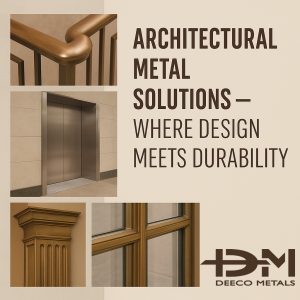
Architectural Metal Solutions – Where Design Meets Durability

Architectural Metal Solutions – Where Design Meets Durability

Custom architectural metal profiles

How DEECO Metals is helping shape the next generation of architectural design.

In architecture, every detail tells a story. From the clean line of a rail profile to the sanded finish of an elevator sill, metal shapes define how a space looks, feels, and performs.

Today’s architects and designers are choosing materials that deliver beauty, longevity, and environmental responsibility. That is where DEECO’s architectural metals excel.

Why Metal Matters in Modern Design

Metal is more than structure; it is a design statement. Architects turn to brass, bronze, nickel silver, stainless steel, steel, and copper for finish options, visual impact, and strength where required.

From elevator entrances to museum doors and windows to corporate interiors, metals combine durability, appreciation and design precision.

“Architectural metals are part of the design language,” says a DEECO Metals spokesperson. “They bring creativity, reflection, and a timeless quality that few other materials can match.”

Design in the Details

In modern spaces, design clarity matters. Architects rely on custom extruded shapes and profiles to create modern, lasting beauty.

Popular applications include:

Each shape supports both form and function, helping teams create environments that are visually balanced and built to last.

Trends Shaping Architectural Metal Design

Looking to 2025 and beyond, architects are redefining how they use metals for aesthetics, flexibility, and long service life. Architectural metals are central to that transformation.

Key trends include:

  • Eco-conscious material choices: Brass, bronze, and stainless steel are fully recyclable and align with green building goals.
  • Custom profiles: Distinctive moldings, trims, rails, and casings that express a project’s identity.
  • High-end finishes: Brushed, polished, plated, or color-etched textures that add shine, contrast, and sophistication.
  • Performance integration: Precision extrusions and appropriate alloys that maintain form and finish for decades.
  • Functional beauty and durability: Shapes that meet safety, accessibility, and design targets in public and private spaces.

These trends show how metal profiles have become a foundation of contemporary architecture, uniting aesthetics and endurance.

Turning Vision into Reality

Every project begins with an idea. DEECO Metals helps transform that idea into reality through engineered extrusions, machined forgings, and castings designed for architectural excellence.

Custom Metal Extrusion capabilities — from heavy walls to very thin walls — include:

  • Custom moldings, trims, and cornices
  • Architectural columns and cladding profiles
  • Handrails, rails, caps, and mounting shapes
  • Metal door and window casings, mullions, and muntins
  • Glass rail moldings, shoe profiles, and channel shapes

DEECO ensures consistent quality, reliable lead times, and JIT stocking programs for projects of every scale.

Built to Last

As materials evolve, one priority remains constant: reliability. DEECO Metals supplies architectural materials that are recyclable, corrosion-resistant, surface treated and engineered / fabricated for long-term performance.

“Our metals are meant to last generations,” DEECO notes. “They allow architects to design with confidence, knowing their materials will maintain strength and beauty over time.”

When design calls for precision, performance, and longevity, DEECO delivers.

📩 Explore custom architectural metal profiles or request our 2025 Standard Handrail Catalog at sales@deecometals.com, visit www.deecometals.com or call 1-800-BRASS-84.

Posted in Extruded Shapes, Uncategorized | Tagged , , , , , | Leave a comment

Copper Bus Bars: Essential for Modern Power Systems

Copper Bus Bars: Essential for Modern Power Systems

Copper Bus Bars

In today’s electrified world, efficiency, safety, and reliability define success in power distribution. At the center of this demand is a component that often goes unnoticed: the copper bus bar. Far more than a simple conductor, copper bus bars are the backbone of modern power systems.

What Is a Bus Bar?

A bus bar is a metallic strip, bar, rod, or custom shape that conducts electricity within a distribution system. Acting as a centralized conductor, it reduces energy loss and simplifies connections between electrical components.

You’ll find copper bus bars in:

  • Data & Energy: Data centers, renewable solar/wind farms, power generators, turbines, waterpower systems, municipal grids
  • Transportation: EVs and charging stations, heavy mining vehicles, railway systems, marine vessels, aerospace
  • Industrial & Commercial: Manufacturing plants, welding equipment, high-rise buildings, heavy machinery
  • Government & Defense: Military bases, defense equipment, municipal power systems

Wherever reliable electricity is needed, copper bus bars play a critical role.

Why Copper Bus Bars Are the Preferred Choice

When it comes to power distribution, not all materials perform the same. Copper stands out for its electrical and thermal conductivity, mechanical strength, and corrosion resistance. Compared to aluminum, copper bus bars deliver:

  • Higher current capacity in smaller dimensions
  • Superior heat dissipation
  • Greater durability under heavy loads
  • Longer service life with fewer failures
  • Excellent thermal conductivity — enhanced further when plated with silver, tin, or gold
  • Higher melting point for demanding environments
  • Strong resistance to corrosion across varied applications

These advantages make copper the material of choice for engineers and manufacturers who demand uncompromising performance.

Copper vs. Aluminum: A Quick Comparison

Aluminum is lighter and less expensive, but its lower conductivity means larger bars are required to carry the same current. This increases space requirements and reduces flexibility.

Copper bus bars provide:

  • Compact efficiency — ideal for space-limited designs
  • Lower energy losses — reduced heat buildup improves safety
  • Consistent reliability — even in the most demanding conditions
  • Better corrosion resistance in harsh environments

Result: Copper bus bars deliver better long-term value in high-performance applications.

DEECO Metals: Precision in Copper Extrusions

At DEECO Metals, we supply ETP C1100 Copper bus bars and custom extruded shapes, in various hardnesses, engineered for maximum performance and reliability. Our capabilities include:

  • Flat rectangular bar, round, square, hexagonal, and custom extruded profiles
  • Plating options: silver, tin, or insulated coatings
  • Flexible production runs to meet unique design requirements

With nearly four decades of metallurgical expertise, DEECO combines global mill partnerships with precision manufacturing to deliver copper solutions that meet the highest industry standards.

Power Your Project with DEECO Metals

For OEMs, architects, and manufacturers who need metals built to perform, DEECO Metals is more than a supplier — we’re your partner in powering the future.

📩 Request a Quote Today
📞 Contact Our Team to Learn More

Posted in Extruded Shapes | Tagged , , , | Leave a comment

Combat Viruses & Infection with Antimicrobial Copper & Copper Alloys

copper antimicrobial properties

Copper is a powerful antimicrobial material with intrinsic hygienic benefits that provides broad-spectrum efficacy against bacteria and viruses. Peer-reviewed, published data from laboratory studies conducted by Professor Bill Keevil at the UK’s University of Southampton shows copper’s ability to quickly and completely inactivate norovirus; other research has proven the material effective against MRSA, E. coli, and other biothreats.

Copper alloys, including brasses and bronzes, share this unique property as well. Results of numerous clinical trials have shown that these materials, collectively known as “antimicrobial copper,” continuously reduce surface contamination by over 80 percent.

A “No Touch” Solution for Touch Surfaces

To help maintain high levels of cleanliness, many healthcare, veterinary, and other clean-critical facilities have replaced frequently-touched surfaces with copper or copper alloy materials. Table tops, desktops, door handles, faucets, drawer, cabinet handles, and even chair arms and computer mice can be swapped out for antimicrobial copper equivalents to reduce the risk of infection and cross-contamination.

Antimicrobial copper materials are also unique in that they are “no touch” solutions—no special measures are needed for them to continuously kill pathogens. Installing copper touch surfaces will create a more hygienic environment, with fewer viruses and bacteria that can cause infections.

Professor Keevil’s findings suggest that antimicrobial copper may also be effective against Ebola and similar viruses. “Based on our research on viruses of similar genetic structure, we expect copper surface to inactivate Ebola and to help control the spread of this virus if employed for publicly-touched surfaces,” Keevil said.

Others, such as Dr. Vinay Ramlaul, who runs a veterinary practice in Harare, Zimbabwe, have installed antimicrobial copper surfaces to help reduce cross-infection between patients. Vinay also points out the materials’ aesthetic benefits. “We’re very pleased with the copper touch surfaces. They’re easy to clean and present a bright, sterile image to our clients,” Vinay said. “We feel secure knowing that copper is continuously killing microbes being transmitted to the surfaces by both our clients and patients.”

Used in conjunction with other infection control measures like thorough handwashing and frequent surface cleaning and disinfection, antimicrobial copper provides another level of protection for patients and practitioners alike.


Antimicrobial Copper from Deeco Metals

Deeco Metals supplies antimicrobial copper and copper alloys in numerous forms, including custom castings, forgings, extrusions, and others. Deeco uses proven manufacturing techniques and extensive expertise to create copper and copper alloy products that match customers’ unique specifications.

For large and small pieces, for simple and complex designs, for high or low volume orders, Deeco Metals delivers high precision antimicrobial copper and copper alloy products for all industries and applications. Deeco provides start-to-finish copper and copper alloy fabrication services, with quick turnaround times and at competitive prices.

Deeco is “the world’s local supplier” for high quality, high precision cast, forged, and extruded antimicrobial copper and copper alloy parts and components. For more information, visit www.deecometals.com.

Posted in Copper, Uncategorized | Tagged , , , , , , , , , | Leave a comment

Deeco on the US Economy

us economy The US economy has been trudging along since 2008, trying to dig itself out of the Great Recession. With hard work, comes great reward as the US is finally in the black. There have been three driving forces helping the US economy bounce back.
The first of which is the lower energy prices. Oil is at its lowest for many years and the USA has become the largest oil producer in the world in a very short period of time!  This is credited to the development of alternative methods of sourcing oil such as fracking.  Oil prices have continued to drop and this decline is allowing the US to be more competitive globally as it drops production and shipping costs. Lower oil prices will allow American goods to be shipped overseas for much cheaper than before, allowing foreign consumers to purchase even more.  A secondary effect is increased spending by Americans, job-creation, and industry-expansion, thus increasing demand from imports.  A rising tide lifts all ships.

The International Monetary Fund estimates that lower energy costs will boost economic growth by 3.5%!

The second driving force will be the increased manufacturing demand from abroad.  Aerospace and automobile manufacturing is still large in the United States and as demand from the Middle East and Asia grows, so will the exports.

The last and possibly most important driving force is technological innovation.  Advanced automation, additive manufacturing, data analytics and the like is changing the manufacturing sector. With an emphasis on STEM education, more and more Americans are ready to tackle the challenges of advanced manufacturing.  CAD, prototyping, and other engineering skills are becoming commonplace and will give the United States a firm advantage in the years ahead.

Due to this increased attention to STEM education and Skilled/Technical Labor jobs, more advanced manufacturing is expected to return to the US in the future, but more on this in later posts.  Perhaps, the lower energy prices currently being experienced and projected for the future are the springboard that the US economy needs to further excel and advance.

2015 Projections

Posted in Uncategorized | Leave a comment

Copper is more antimicrobial than stainless steel

copper vs stainless steel antimicrobial properties

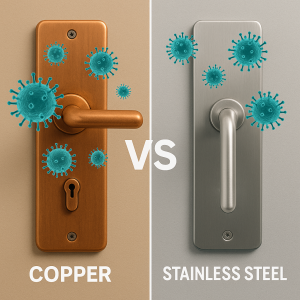
Stainless steel products are prominent in hospitals and public places throughout the United States and the world; however, it may not be the best material option used.  In fact, studies show that copper is significantly more antimicrobial than stainless and kills more germs on contact than most all other metals.

Stainless steel is used throughout the hospital including surgery areas, bed rails, handrails, door handles and more.  When it comes to having the most sterile environment possible, copper and brasses are the material the medical industry needs to start choosing over stainless steel.  Professor William Keevil is a microbiological researcher and Head of Environmental Research at the University of Southampton, United Kingdom and his studies show that the super-virus MRSA simply will not last when in contact with copper, but continues to grow when in contact with stainless steel. This finding is very important, as MRSA is highly contagious!

The U.S. Environmental Protection Agency (EPA) tested this theory and the end result is that the EPA has now registered more than 350 copper alloys with a minimum copper content of 60% as antimicrobial.

The EPA studies show that uncoated copper alloys will kill more than 99.9% of bacteria within two hours of contact to the surface of the copper parts.  This will protect patients and hospital workers from various bacteria causing illnesses.  It has also been proven through clinical trial research that even tarnished copper won’t change the high effectiveness.

There are a few conditions to keep in mind when it comes to the effectiveness of coppers antimicrobial components.  For one, the copper products must never be painted, varnished or covered in any way.  The copper must also be cleaned regularly, and they are not registered for use to eat off it or drinking from it.

It is important to remember that when it comes to hospitals, public transportation, schools, shopping centers, care homes, private homes and cruise ships, to name a few common locations with surfaces that are touched by people, parts made out of copper and its alloys should be used for these applications.  The medical industry is leaning towards components made out of copper and its alloys as the surfaces of these items are much more effective in killing germs than stainless steel.  More and more people in the medical industry are discovering that copper is a highly effective antimicrobial option, which will continue to steer the industry towards a more sterile tomorrow. And as the medical industry turns towards copper, the other industries that can benefit may soon use copper as well.  Below are just a few examples of organizations already adopting this material:
Pullman Regional
Sentara Healthcare: Copper-Infused Linens
Copper Door Handles: the new standard

Posted in Uncategorized | Leave a comment

Manufacturing Day

MFGDay14_Logo_Date_ColorOn October 3rd, 2014 we celebrate Manufacturing Day in the USA.

This is the day that manufacturers open their doors and show what manufacturing is all about. This is a great time to open our doors and invite you to understand what Deeco Metals  is all about.

We began business in 1986 as a North American sales office for several international metal producers who were supplying metal components to OEM’s throughout the USA.  Our goal was to create a company that would serve the USA, Canada and South America by assisting companies in determining the best manufacturing process and the most suitable metal in order to obtain the highest quality, yet most cost-effective parts available. The key in accomplishing this was by making our technical background and experience available to anyone who believed that they would benefit by this knowledge.

We are privileged and happy to serve customers from our location in NJ to anywhere in the USA.  We appreciate the fact that prospective customers contact us to fill their needs and, as such, are happy to offer recommendations on how to move forward.

We strive for open dialogue with our customers about their needs as well as honest discussions on price, quality and service, all of which are important to you our customers. This kind of trust allows us to build a lasting relationship with our customers, some who have been buying from us for over 24 years.

Oftentimes, customers’ needs do not fall within our scope of supply and when this happens, we will try to recommend someone who may be able to fulfill their needs. If we can provide the needed products, we will provide you pricing that includes all tooling and material charges. If the prospective customer likes our offering, a PO is placed, tooling is manufactured and first article samples, produced from this new tooling, are provided. These samples are then inspected and if all is to the customers expectations, approval to proceed is given. One plus is that the samples can also be used as prototypes, while the production goods are being finished. This process ensures that everyone is happy with the products performance and ensures that future quality will meet the customer’s quality needs.

All our manufacturing plants are ISO certified, which further enforces our desire to offer our customers high-quality parts at the best and lowest prices.

We are located in Irvington, New Jersey, just minutes from New York City and our location has us close to the commercial shipping ports of New Jersey and New York.  We are in the center of all major trucking routes and our 15,000 sq. ft. warehouse houses a large just-in-time inventory of strategic customer metal products.

Our manufacturers are based in China, Spain, Italy, Turkey, South Africa, India, Korea and Taiwan so we can supply you good quality at the most competitive prices that assist you reduce your product costs!

Let’s celebrate together with an inquiry for your custom made metal products to obtain some COST SAVINGS!

Posted in manufacturing | Tagged | Leave a comment

Architectural Metal Castings

Deeco can assist with all of your casting needs. From your initial conceptual sketches to the casting designs to an engineered drawing that produce the final metal casting.

We have a full service metal sand cast and investment cast foundry that produces custom Architectural Metal Castings in Aluminum, Brass, Bronze, Cast Irons, Ductile Irons, Carbon and Stainless Steels.

We can supply Architectural Metal Castings to any level of completion, from an as-cast condition with a shot blast surface or vibratory surface finish, all of the way through to a fully machined product. Castings can be provided with assembled sub-components like fasteners and also with secondary welding, as needed. These can be supplied in most surface finishes, such as powder coated, hand painted, anodizing, acid etching and patinas, all to a wide variety of colors and finishes.

We can use your 2D and 3D drawings or old original architectural metal castings samples to produce molds or patterns to replicate the desired castings, all in many different metal alloys.  We offer quantities ranging from 20 pcs and up, depending upon the weight of the parts.

Our metal castings are used for the restoration of historic building projects to new construction projects. These projects can be for the commercial, residential, institutional and governmental sectors.

Castings are made for lighting and lamp posts, gates and fencing, fountain parts, garden furniture, mailboxes, posts and caps, windows, elevator interiors, railings, hardware, flag staff components, corners and brackets, ornamentation and decoration items and many other architectural products.

We pack and ship castings to your location in special wooden cases to protect your product from damage.

In addition to the castings, we also supply custom extruded architectural brass and bronzes shapes as well as forged parts for the architectural industry.

Take a look at some of our past work below and please send us your Architectural Metal Castings inquiries.

Corner Medallion

Corner Medallions

Aluminum Rosettes

Rosettes Aluminum

Top Grill Original Bronze

Top Grill-Bronze

Corner Medallion with Bronze

Corner Medallion With Bronze

Posted in Metal Castings | Tagged , , | Leave a comment