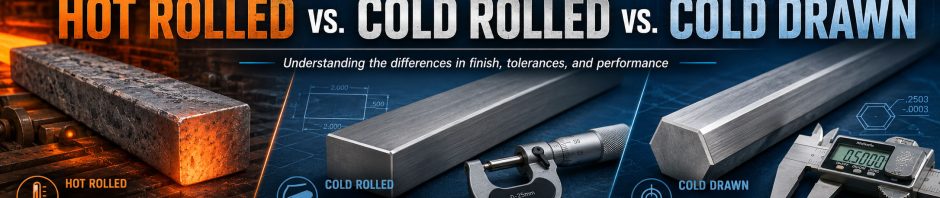
When comparing hot rolled vs cold rolled vs cold drawn metal, it is important to understand how each manufacturing process affects dimensional accuracy, surface finish, strength, hardness, machinability, and final part performance.
In many cases, these terms apply most directly to steel and stainless steel products. Brass, bronze, copper, and nickel silver are generally more commonly associated with extrusion, drawing, machining, casting, or forging, depending on the application. However, many non-ferrous alloys can also be cold drawn to improve dimensional tolerances, straightness, surface finish, and mechanical properties.
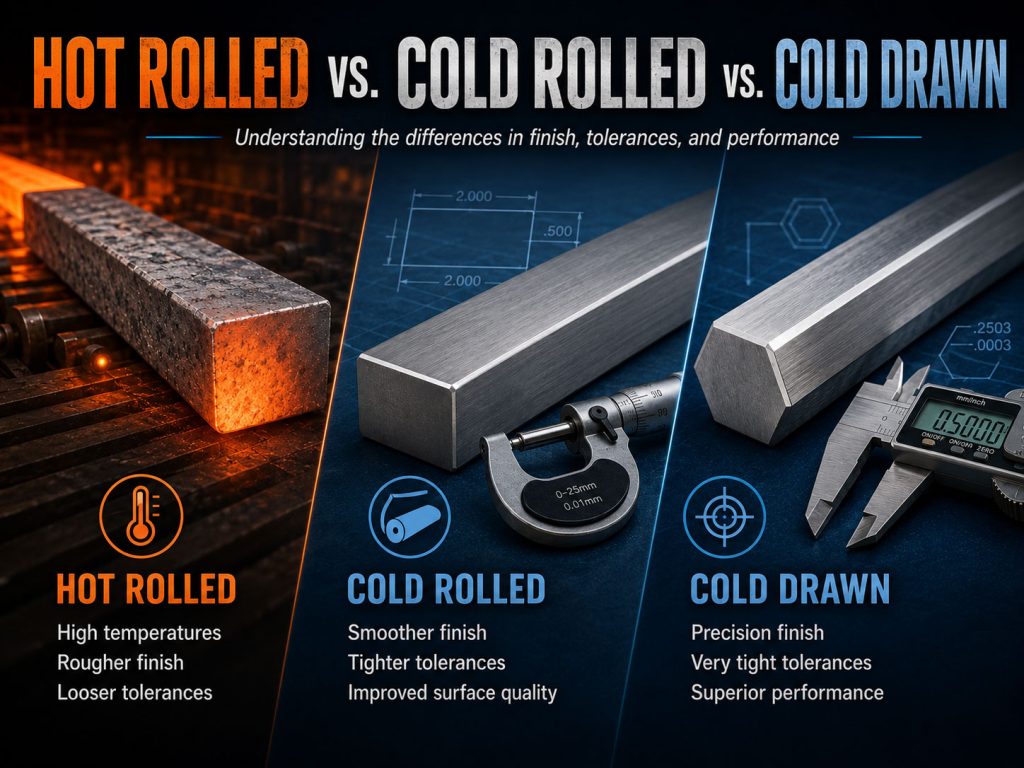
When sourcing custom metal shapes, bars, rods, or profiles, the manufacturing process can be just as important as the alloy itself.
At DEECO Metals, we help customers determine the most practical manufacturing route based on material selection, shape complexity, tolerance requirements, surface finish expectations, mechanical property requirements, production volume, and end-use application demands.
What Is Hot Rolled Metal?
Hot rolling forms metal at elevated temperatures. The material is heated and passed through rollers to achieve the desired plate thickness, bar size, or structural shape.
Because the metal is formed while hot, it is easier to shape and is commonly used for larger sections and industrial applications where extremely tight tolerances or refined surface finishes are not the primary requirement.
Hot rolled metal is commonly used when:
- The part is larger or thicker
- The application is structural or heavy-duty
- Surface finish is not the primary concern
- The material will later be machined, plated, coated, or finished
- Cost-effective production is important
What Is Cold Rolled Metal?
Cold rolling processes metal at or near room temperature, typically after it has already been hot rolled. This improves surface finish, dimensional consistency, thickness control, strength, and hardness.
Cold rolled material is commonly associated with sheet, strip, flat bar, and round bar. It is often selected for applications requiring a cleaner appearance and tighter dimensional control than hot rolled material can typically provide.
Cold rolled metal is commonly used when:
- A smoother surface is required
- Better dimensional accuracy is needed
- Thickness consistency is important
- The part will remain visible in the final application
- Improved mechanical properties are beneficial
What Is Cold Drawn Metal?
Cold drawing is a process where oversized bar, rod, tube, wire, or shaped material is pulled through a precision die at or near room temperature. This reduces the cross-section while improving dimensional tolerances, straightness, surface finish, and mechanical properties.
Cold drawn material may also be annealed between reductions to achieve additional size reduction or specific mechanical properties.
Cold drawing is commonly used for precision bars, tubes, wire, simple shapes, and some custom profiles.
Cold drawn metal is commonly used when:
- Tight dimensional tolerances are required
- A custom profile or precision shape is needed
- Straightness and repeatability are critical
- A smooth or bright finish is desired
- The shape will be automatically machined using collets
- The profile will be incorporated into assemblies, such as handrail systems
- Reduced machining time and material scrap are important

Quick Comparison: Hot Rolled vs. Cold Rolled vs. Cold Drawn
| Feature | Hot Rolled | Cold Rolled | Cold Drawn |
|---|---|---|---|
| Process | Formed at elevated temperatures | Rolled near room temperature after hot rolling | Pulled through a die near room temperature |
| Common Forms | Structural bars, plates, shapes | Sheet, strip, flat bar, round bar | Rods, bars, tubes, wire, custom profiles |
| Surface Finish | Rougher, may contain scale | Smoother and cleaner | Bright, smooth, and consistent |
| Dimensional Accuracy | General-use tolerances | Better than hot rolled | Highest precision |
| Mechanical Properties | Structural strength | Increased hardness through cold working | Increased strength and dimensional control |
| Best Suited For | Structural and industrial use | Surface quality and consistency | Precision parts and custom profiles |
Why the Manufacturing Process Matters
Choosing between hot rolled vs cold rolled vs cold drawn metal can affect cost, lead time, machinability, cosmetic appearance, assembly performance, and long-term reliability.
A hot rolled steel profile may be ideal for a heavy industrial application. Cold rolled material may be preferred where a smoother finish and tighter thickness control are needed. Cold drawn profiles are often selected for precision applications that require tight tolerances, repeatability, improved straightness, and enhanced mechanical properties.
The correct manufacturing route depends on the part geometry, alloy selection, application requirements, surface finish expectations, and any secondary machining or finishing needs.
DEECO Helps Match the Process to the Application
Customers do not always need to know whether a component should be hot rolled, cold rolled, cold drawn, extruded, cast, forged, or machined. That is where DEECO Metals’ technical sourcing experience adds value.
When you provide drawings, samples, material requirements, application details, or performance expectations, DEECO can help determine the most practical manufacturing solution.
We evaluate:
- Material selection
- Shape complexity
- Tolerance requirements
- Surface finish needs
- Mechanical property targets
- Production volume
- Secondary machining and finishing
- Packaging, JIT stocking, and delivery requirements
Custom Metal Shapes and Components
When a project requires more than a standard metal shape, DEECO Metals helps customers source custom metal shapes and components across brass, bronze, copper, nickel silver, stainless steel, aluminum, carbon and alloy steels, castings, forgings, drawn shapes, extrusions, and finished parts.
Our products may be cold drawn, extruded, hot rolled, cast, forged, or precision machined depending on the application requirements.
Request a Quote
Whether your project requires a hot rolled structural profile, cold rolled material, or a precision cold drawn custom shape, DEECO Metals can help determine the best manufacturing process and alloy for your application.
We support customers across architectural, industrial, OEM, electrical, hardware, elevator, and manufacturing markets with precision-engineered metal components designed for demanding applications.
Contact DEECO Metals to discuss your next custom metal shape, profile, or component.
📞 Contact your DEECO Metals Sales Representative
📧 sales@deecometals.com ☎️ 800-272-7784 🌐 deecometals.com