When specifying a metal handrail for an architectural project, the right profile does more than complete the look. It can affect installation, durability, code-related performance, long-term maintenance, and how well the finished space comes together visually.
Whether the project involves new construction, renovation, or historic restoration, selecting the right handrail profile starts with understanding both the functional requirements and the design intent. The best choice is not always the most decorative or the most familiar. It is the one that fits the application, complements the surrounding architecture, and supports reliable long-term performance.
At DEECO Metals, we supply architectural handrail profiles in a range of metals and shapes to support both standard and custom project needs. Our standard handrail offerings help architects, contractors, fabricators, and restoration teams find practical solutions without sacrificing appearance.
Start with the Type of Project
The first step in choosing a handrail profile is understanding the type of project you are working on.
A new commercial building may call for a clean, consistent profile that fits a broader modern design language. A university, civic building, church, theater, or historic restoration may require a more traditional or decorative look that aligns with existing architectural details. In renovation work, the goal may be to match or complement surrounding trim, mouldings, rail components, or legacy profiles already in the building.
Project type influences more than appearance. It can also shape expectations for finish, mounting method, profile complexity, and whether the handrail needs to blend in or serve as a visible architectural feature.

Consider the Desired Style and Visual Impact
Handrails are often both functional and decorative. In some spaces, they are meant to quietly support the design. In others, they help define it.
The right profile depends on the look you want to achieve. Some projects call for a more traditional architectural appearance with softer lines and classic detailing. Others benefit from a more streamlined profile suited to contemporary commercial interiors, institutional settings, or public spaces.
This is also where material choice becomes important. Brass, bronze, nickel silver, stainless steel, steel, and copper each bring a different visual character to the finished installation. Some projects prioritize warmth and elegance. Others require a cleaner or more understated appearance. Choosing the right combination of metal and profile can help achieve the intended result.
Choose a Profile That Fits the Application
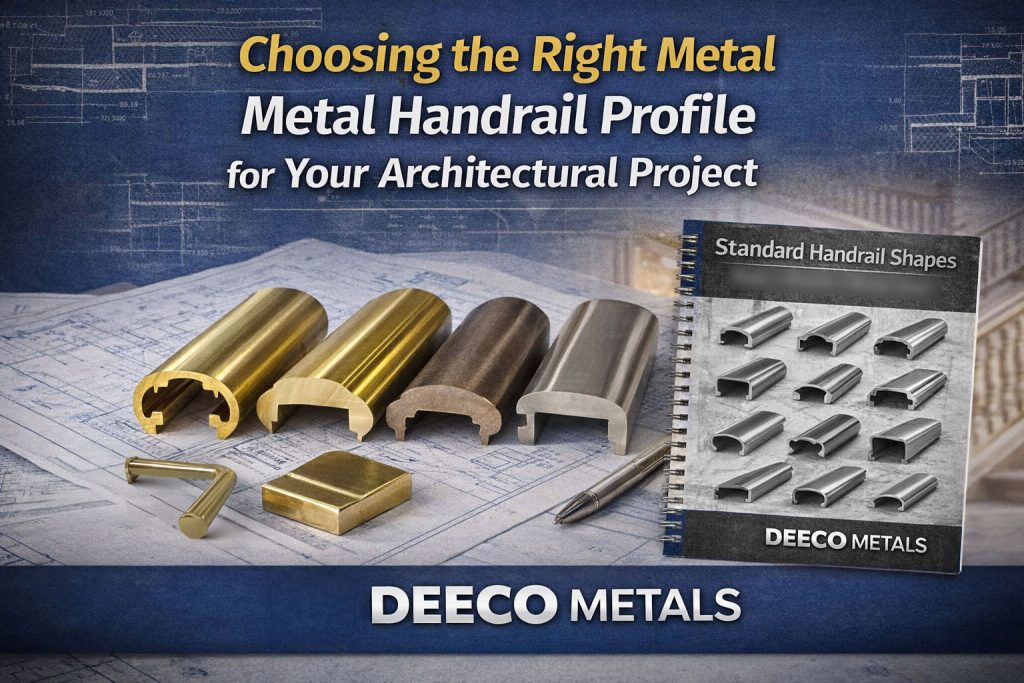
Different handrail profiles serve different design and installation needs. Standard architectural handrails can include options such as round and flat cap handrails, guard handrails, lamb tongue shapes, volutes, nosings, brackets, mounting bars, glass rail moldings, glass channels, shoe moldings, and slotted cap shapes.
The best option depends on the project layout, mounting condition, surrounding materials, and overall architectural style.
For example, one project may benefit from a profile designed for a traditional stair rail, while another may call for a profile that integrates cleanly with glass or modern wall-mounted systems. In restoration work, the right profile may be the one that most closely matches an original detail. In new construction, it may be the one that balances appearance, installation efficiency, and manufacturability.
Think Beyond the Rail Itself
A successful handrail system involves more than the main profile alone.
Mounting bars, brackets, transitions, and adjacent trim components all affect how the final installation looks and performs. These supporting pieces can influence ease of installation, structural stability, and how cleanly the handrail integrates with the wall, guard system, or stair assembly.
That is why it is helpful to think about the full system early, not just the visible rail shape. Looking at the broader assembly can help prevent design mismatches and reduce surprises during fabrication and installation.
Select the Right Metal for Performance and Appearance
Material selection plays a major role in both the visual effect and practical performance of an architectural handrail.
Brass, bronze, and nickel silver are often selected for their timeless appearance and strong fit with architectural and decorative applications. Stainless steel and steel may be preferred where durability, modern styling, or a different finish character is desired. Copper can also be used where its distinct appearance or other material characteristics support the design intent.
The right metal depends on the environment, the desired finish, how visible the handrail will be, and whether the project calls for a traditional, historic, or contemporary look.
Consider Fabrication and Forming Needs
Not every handrail project is the same from a fabrication standpoint.
Some handrail profiles may be better suited for straight runs, while others may need to accommodate bending, transitions, or matching conditions in the field. Depending on the material and profile, solid or hollow shapes may also be considered based on the application.
In some cases, a standard shape may be the right fit. In others, the project may require a modified or custom solution. For restoration work especially, the ability to replicate an existing shape from a sketch or cut sample can be important when maintaining architectural continuity.
Thinking about these details early can help ensure the selected profile is not only visually appropriate, but also practical to produce and install.
Standard Profiles Can Simplify Selection
For many projects, starting with a standard handrail catalog can save time and help narrow the field more quickly.
Rather than beginning from scratch, architects, contractors, and fabricators can review proven profile options and identify shapes that align with the project’s design and installation requirements. This can help speed up decision-making and provide a useful starting point for discussion.
DEECO Metals’ 2025 Standard Handrail Catalog was developed to make that process easier by presenting a range of commonly requested handrail profiles in Brass, Bronze, and Nickel Silver for architectural applications.
The Right Profile Supports the Whole Project
Choosing a metal handrail profile is not just a finish selection. It is a design and performance decision that affects how the project looks, how the system installs, and how well it performs over time.
By considering project type, profile style, supporting components, material, and fabrication needs early in the process, architects and builders can make more confident choices and reduce the likelihood of delays or redesign later.
Whether you are working on a new build, a renovation, or a historic restoration, the right handrail profile can help bring strength, continuity, and architectural character to the finished space.
Request the DEECO Metals 2025 Standard Handrail Catalog
If you would like to review standard handrail options for your next project, contact DEECO Metals to request a copy of our 2025 Standard Handrail Catalog.
📞 Contact your DEECO Metals Sales Representative
📧 sales@deecometals.com ☎️ 800-272-7784 🌐 deecometals.com